
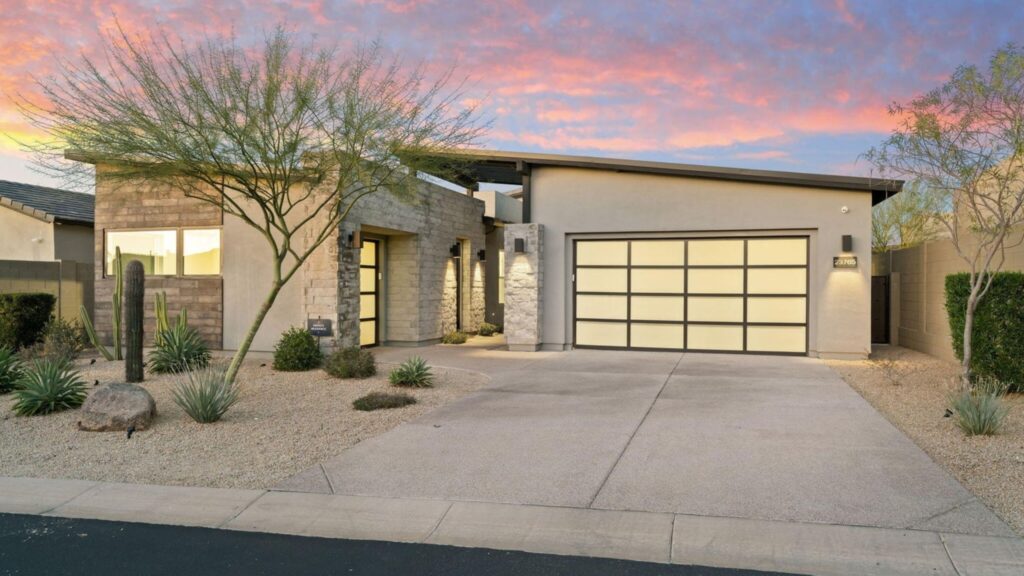
Almost every buyer shopping North Scottsdale eventually hits this fork in the road. On one side, a brand-new home with nothing worn, nothing dated, and finishes you picked yourself. On the other, an established home in a mature neighborhood with trees, finished landscaping, and a price you can actually negotiate.
Neither is automatically the smarter choice. But the comparison is rarely as simple as the list prices make it look, and most of the surprises run in one direction. Here’s what the numbers and the experience actually look like on each side.
The Price You See Isn’t the Price You Pay
This is the single most important thing to understand about new construction, and the one that catches the most buyers off guard.
The advertised base price of a new home covers the base home: standard finishes, standard layout, standard lot. Almost nobody buys the base home. Between the design center, lot premiums, and structural options, the final price on a new build commonly ends up well above the number on the sign.
Design center upgrades are where budgets stretch most. Flooring, cabinets, countertops, lighting, plumbing fixtures, and appliances all have tiers, and the standard options are often noticeably more basic than what you saw in the model home. The models are almost always built with top-tier upgrades throughout, which is worth remembering before you fall in love with one.
Lot premiums can be substantial. Lots with mountain views, lots backing to open space, larger lots, and cul-de-sac positions all carry extra charges. In North Scottsdale, where views are a major part of value, the premium for a good lot can be significant.
What’s not included is the other half of the equation. Depending on the builder, a new home may come without backyard landscaping, fencing or view fencing, window coverings, a pool, or certain appliances. In Arizona, finishing a backyard is not a small project. A pool, hardscape, shade, and landscaping can add a large amount of cost and several months of work after you move in.
A resale home in an established North Scottsdale neighborhood, by contrast, typically comes with all of that already done. The pool is in, the landscaping is mature, the window coverings are hung. When you compare a new build to a resale, compare the finished, livable version of each, not the base price to the list price.
Negotiating Power Works Differently
Resale sellers are individuals. Their willingness to negotiate depends on their timeline, how long the home has been listed, and the state of the market. In a slower stretch or with an aged listing, there’s often real room to move on price, repairs, and terms.
Builders are different. They generally protect their base prices carefully, because cutting the price on one home affects the appraisals and perceived value of every other home in the community. When builders want to move inventory, they tend to do it through incentives instead: help with closing costs, interest rate buydowns through their preferred lender, or credits toward upgrades.
Those incentives can be genuinely valuable, particularly rate buydowns. But they’re often tied to using the builder’s affiliated lender and title company, so it’s worth comparing the full package against an outside lender rather than assuming the incentive is the best deal available.
Quick move-in homes, sometimes called spec or inventory homes, are the exception worth knowing about. These are homes the builder has already started or finished without a buyer. Builders are usually more motivated to move them, and they’re where the most flexible deals tend to appear.
Timelines
A resale purchase typically closes in 30 to 45 days. You know exactly what you’re getting and exactly when.
A new build from the ground up usually takes many months, and delays are common. Weather, material availability, labor, and permitting all affect the schedule. If you’re selling a current home, relocating for a job, or coordinating around a school year, that uncertainty matters. Carrying two homes or arranging interim housing because a completion date slipped is an expensive and stressful surprise.
Quick move-in homes split the difference, offering new construction on a much shorter and more predictable timeline, with the trade-off that most finish choices have already been made.
Location and Setting
In North Scottsdale, where new construction is available is shaped by where land is available. Established communities like McDowell Mountain Ranch, Grayhawk, and much of DC Ranch are largely built out, which means buying there usually means buying resale.
That matters because those established communities come with things a new development can’t offer yet: mature trees and landscaping, proven schools, finished amenities, established neighborhood culture, and a track record of how home values have held up. New developments tend to sit farther out, and they’re still becoming whatever they’ll eventually be.
There’s also the construction itself. Buying early in a new community often means living alongside ongoing building for a while: noise, dust, trucks, and unfinished amenities. Some buyers don’t mind. Others find it wears on them.
If a specific established neighborhood is what you want, the decision is effectively made for you. If you’re flexible on location, new construction widens your options.
Condition, Maintenance, and Efficiency
This is where new construction has a clear, real advantage.
A new home comes with new roofing, new HVAC, new water heater, new appliances, and new everything else. You won’t be replacing any major system for a long time. Builders also typically include a warranty, commonly structured with shorter coverage on workmanship and systems and longer coverage on structural elements, though the details vary by builder and are worth reading closely.
Newer homes are also generally built to more recent energy codes, with better insulation, more efficient windows, and more efficient HVAC. In a climate where summer cooling costs are significant, that difference shows up on the monthly bill.
Resale homes vary widely here. A well-maintained 15-year-old home may be in excellent shape. Another of the same age may be approaching the end of life on its roof underlayment, HVAC, and water heater at the same time. The inspection tells you which one you’re looking at, and the cost of upcoming replacements should factor into your offer.
Get the New Build Inspected Anyway
A common and costly assumption is that a new home doesn’t need an inspection. It does.
New homes pass municipal inspections, but those check for code compliance, not quality of workmanship. Independent inspectors regularly find issues in brand-new construction: missing insulation, incorrectly installed components, drainage problems, and finish defects.
Many buyers arrange inspections at multiple stages, including before drywall goes up, when framing, plumbing, and electrical are still visible, and again before closing. It costs a little more and catches problems while they’re still easy to fix. Before your warranty expires, a final inspection to document anything that needs addressing is also worth the money.
The HOA Question
Most of North Scottsdale is governed by HOAs either way, but new and established communities often handle them differently.
In a new development, the builder frequently controls the HOA until a certain portion of the homes are sold. During that period, fees may be set to look attractive, and reserves are still being built. Once homeowners take over, fees sometimes adjust to reflect the real cost of running the community.
Established community HOAs have a track record you can examine: years of budgets, reserve studies, meeting minutes, and fee history. That’s useful information that a brand-new association simply doesn’t have yet.
Bring Your Own Agent, and Do It From the Start
The salesperson in a builder’s model home works for the builder. They can be friendly and helpful, but their job is to sell that builder’s homes on that builder’s terms.
Having your own agent represent you in a new build is generally paid by the builder rather than by you, and it gets you someone reviewing the contract, comparing incentives, advising on which upgrades hold value, and advocating for you if problems come up during construction.
One important detail: many builders require your agent to be present or registered at your very first visit. If you walk into a model home alone and sign in, you may lose the ability to have representation on that purchase. Bring your agent before you tour, not after.
So Which Should You Choose?
New construction tends to make more sense if:
You want everything new, with warranty coverage and lower near-term maintenance. You care about energy efficiency and modern layouts. You have flexibility on timing and location. You’re comfortable budgeting for upgrades, landscaping, and a backyard.
Resale tends to make more sense if:
You want a specific established neighborhood. You value mature landscaping, finished amenities, and a known community. You need a predictable closing date. You want to negotiate price and terms directly. You’d rather move in and live than spend a year finishing a backyard.
The buyers who end up happiest usually made the comparison on the finished, move-in cost of both options rather than the sticker prices. Do that math honestly and the right answer tends to become obvious.
Weighing a new build against an existing home in North Scottsdale? Reach out for a straight comparison of what’s available and what each option would really cost.